Choosing between Computer Science and IT colleges in Tanzania is one of the biggest decisions facing secondary school leavers today. As the country’s digital economy expands through e-government initiatives, mobile banking, and a growing startup scene, demand for graduates in these fields has never been higher. This guide breaks down where to study, what each course actually involves, and how the two fields differ in practice.
Why Tech Education Matters in Tanzania Right Now
Tanzania’s technology sector is growing rapidly, driven by government investment in digital infrastructure, smart cities projects, and the expansion of mobile money platforms. Banks, telecom companies, hospitals, and government agencies all need skilled professionals who can write software, manage networks, and secure digital systems. This has pushed both public and private universities to expand their computing departments and introduce new specializations such as cybersecurity, data science, and artificial intelligence.
Top Universities Offering Computer Science
University of Dar es Salaam (UDSM) – College of Information and Communication Technologies (CoICT): This remains the most established computing college in the country, offering Computer Science, Computer Engineering, and Telecommunications Engineering with strong research infrastructure and well-equipped laboratories.
University of Dodoma (UDOM): UDOM has built a solid reputation for its Computer Science and IT programs, alongside strong offerings in education, business, and health sciences.
Nelson Mandela African Institution of Science and Technology (NM-AIST), Arusha: Known for postgraduate-focused, research-heavy programs in computational and communication sciences.
Mbeya University of Science and Technology (MUST): Originally a technical college, MUST now offers both diploma and degree programs in engineering and computing.
Sokoine University of Agriculture (SUA), Morogoro: SUA’s Diploma in Information Technology produces graduates skilled in computer hardware, networking, and software development, often at more affordable tuition than larger urban universities.
Ardhi University (ARU), Dar es Salaam: A good fit for students who want IT combined with GIS, urban planning, and land information systems.
Technical and Diploma Colleges
For students who prefer practical, hands-on training over a full degree, technical colleges regulated by NACTVET offer strong alternatives:
- Dar es Salaam Institute of Technology (DIT): Long-established and well-regarded for electrical, mechanical, electronics, and IT diploma programs, with graduates finding jobs quickly in major companies.
- Arusha Technical College (ATC): Focuses on engineering and IT with a strong emphasis on practical, industry-linked training.
These NTA Level 4–6 diploma programs typically take two to three years and provide a faster route into the job market, with the option to bridge into a bachelor’s degree later.
Computer Science vs IT: What’s the Real Difference?
Many students confuse these two fields, but they lead to different day-to-day work.
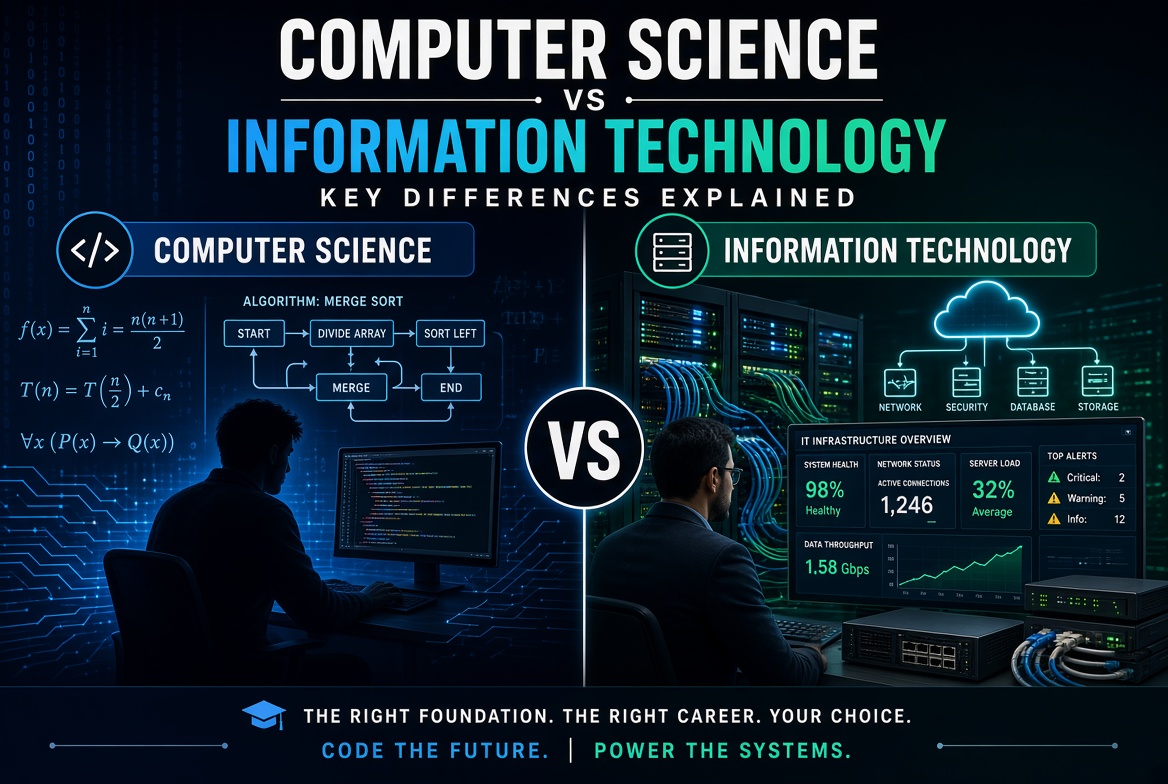
Computer Science professionals deal with the theoretical and mathematical foundations of computing. Their work centers on algorithms, data structures, software design, and programming languages. A computer scientist is the person who builds new software systems, designs mobile applications from scratch, or works on artificial intelligence models. The field demands strong problem-solving skills and comfort with abstract, mathematical thinking.
IT professionals, on the other hand, focus on applying existing technology to solve everyday business problems. This includes managing computer networks, maintaining servers, configuring hardware, providing technical support, and keeping an organization’s systems running securely. An IT specialist is typically the person a company calls when the internet goes down, when a new employee needs computer access set up, or when data needs to be backed up safely.
In short: Computer Science is about building technology, while IT is about deploying and maintaining it. Both are essential, and many Tanzanian colleges now blend elements of both into their curricula to produce well-rounded graduates.
How to Choose the Right College
Before applying, consider:
- Your CSEE/ACSEE results – most Computer Science degree programs require strong passes in Mathematics and Physics.
- Location and cost – urban universities like UDSM tend to have higher living costs than colleges in Morogoro, Mbeya, or Dodoma.
- Career goals – if you want to design software or pursue AI research, lean toward Computer Science; if you prefer network administration or IT support roles, a diploma-focused IT program may get you into the workforce faster.
- Accreditation – always confirm a college’s programs are approved by TCU (for universities) or NACTVET (for technical colleges) before applying.
Final Thoughts
Tanzania now offers a wide range of solid options for students interested in technology, from research-driven university programs at UDSM and UDOM to practical, job-ready diploma courses at DIT and ATC. Understanding the distinction between Computer Science and IT will help you choose a path that matches both your strengths and your career ambitions.