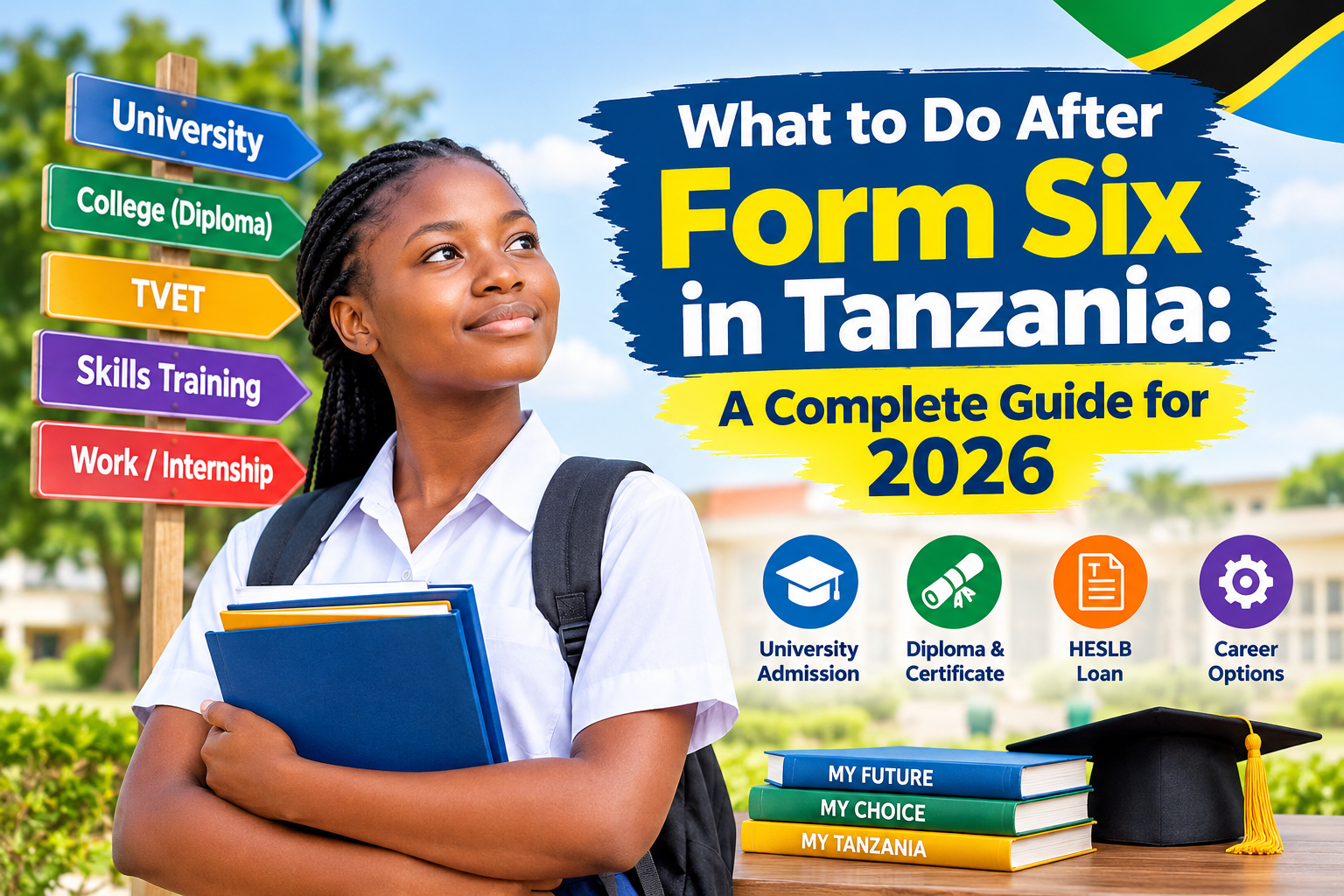
Finishing Form Six is one of the biggest milestones in a Tanzanian student’s academic journey, but it also comes with a wave of uncertainty. Once the excitement of completing A-Level exams fades, many students are left asking the same question: what to do after Form Six in Tanzania? The good news is that there is no single “correct” path. Depending on your NECTA results, financial situation, and personal interests, there are several realistic and rewarding routes you can take.
This guide breaks down the most practical options available to Form Six graduates in Tanzania, along with tips on how to choose wisely.
1. Apply to a Public or Private University
For most students, joining a university is the natural next step. Tanzania has a growing number of accredited institutions, including the University of Dar es Salaam (UDSM), Muhimbili University of Health and Allied Sciences (MUHAS), Sokoine University of Agriculture (SUA), Ardhi University, Mzumbe University, and the Nelson Mandela African Institution of Science and Technology (NM-AIST).
Applications are coordinated through the Tanzania Commission for Universities (TCU) Admission System, and it is important to apply as soon as the portal opens, since some competitive programs like medicine, engineering, and law fill up quickly. Before applying, check the specific subject combination and minimum points required for your intended course, as these vary between institutions and programs.
If your Form Six results are strong, this is often the fastest way to build toward a professional career such as medicine, law, engineering, or teaching.
2. Consider TVET and Technical Colleges
Not every student needs a university degree to build a successful career. Technical and Vocational Education and Training (TVET) institutions, such as the Dar es Salaam Institute of Technology (DIT), Arusha Technical College (ATC), and various VETA colleges, offer diploma and certificate programs in fields like electrical engineering, ICT, construction, hospitality, and automotive technology.
These programs are typically shorter than a university degree, more affordable, and highly practical, meaning graduates often enter the job market with hands-on skills employers actively need. For students who prefer a hands-on learning style over long theoretical study, TVET pathways can lead to stable employment or even self-employment within a shorter timeframe.
3. Search and Apply for Scholarships
Financing further education is one of the biggest challenges Form Six graduates face. Thankfully, there are several scholarship opportunities available for Tanzanian students, both locally and internationally.
Locally, the Higher Education Students’ Loans Board (HESLB) provides loans to eligible students joining accredited universities and colleges. Internationally, organizations and partner governments periodically offer fully funded or partially funded scholarships in fields ranging from engineering to public health. It is worth checking updates regularly on official scholarship boards and university websites, since application deadlines can be strict and competition is often high.
Preparing your documents early, including academic transcripts, a passport, and recommendation letters, can make the difference between missing a deadline and securing life-changing funding.
4. Join Professional and Short Courses
If you are not ready to commit to a full degree program immediately, short professional courses can be a smart bridge. Certifications in digital marketing, graphic design, accounting software, project management, or coding can be completed in a few months and significantly boost your employability.
Many of these courses are available both online and through local training centers in cities like Dar es Salaam, Mwanza, and Arusha. This route works particularly well for students who want to start earning income sooner while still building valuable, marketable skills.
5. Explore Employment and Internship Opportunities
Some Form Six graduates choose to enter the workforce directly, particularly in entry-level roles or internships that do not require a university degree. Sectors such as retail, customer service, agriculture, and small business support often have openings suitable for young graduates.
An internship, even an unpaid or low-paid one, can also be valuable because it builds real work experience, professional references, and a clearer sense of which career path might suit you before committing years to a specific degree program.
6. Consider Entrepreneurship
For students with a business mindset, starting a small venture after Form Six is another viable path. Tanzania’s growing digital economy has made it easier to start businesses in areas like online selling, content creation, agribusiness, or service-based work with relatively low capital.
Entrepreneurship requires discipline and often a willingness to learn as you go, but for the right person, it can be more rewarding than waiting years for formal employment. Local business incubators and youth entrepreneurship programs can offer mentorship and startup support for those willing to seek them out.
7. Retake NECTA Exams if Necessary
If your Form Six results were lower than expected and do not meet the entry requirements for your desired program, retaking specific subjects through NECTA is an option worth considering. This allows you to improve your points and reapply for competitive courses in the following academic cycle.
While this path requires patience, it can be the right choice for students determined to pursue a specific profession, such as medicine or engineering, where minimum point requirements are strict.
How to Choose the Right Path
With so many options, deciding what to do after Form Six in Tanzania comes down to a few honest questions:
- What are your Form Six results, and which programs do they qualify you for?
- What is your financial situation, and do you need a scholarship or loan?
- Do you prefer academic study or hands-on technical training?
- Are you willing to wait for a long-term career, or do you need income sooner?
Talking to school counselors, teachers, and professionals already working in your field of interest can also provide clarity that online research alone cannot offer.
Final Thoughts
There is no one-size-fits-all answer to what to do after Form Six in Tanzania. Whether you choose university, TVET, a scholarship application, a short course, employment, entrepreneurship, or a NECTA retake, the most important step is making an informed decision based on your results, goals, and circumstances. Take time to research your options thoroughly, seek guidance where needed, and remember that this decision is the beginning of your career journey, not the final word on it.
RELATED POST :